Korean pharmacy skincare: what the box label tells you, and when to see a dermatologist instead
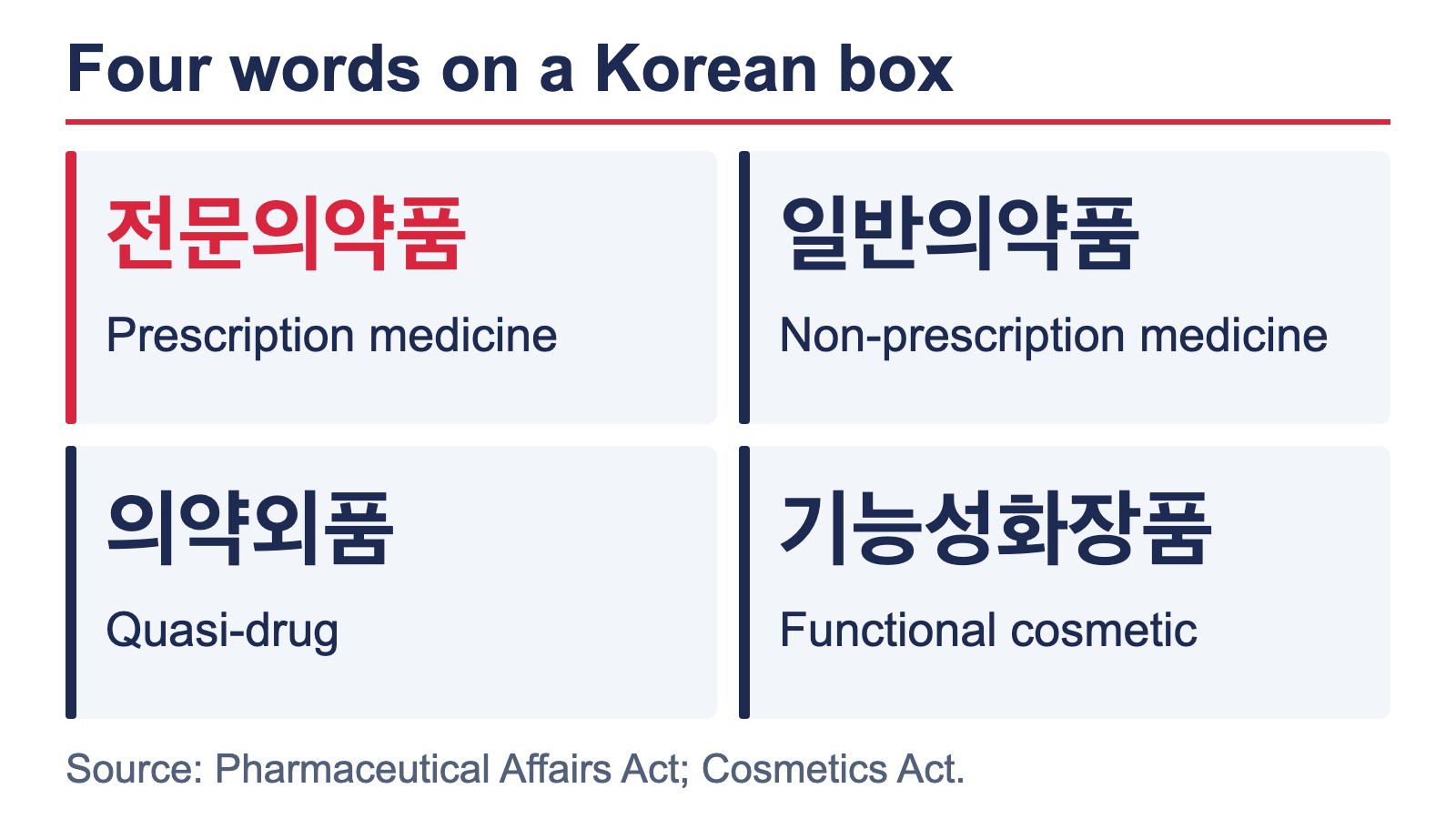
Look for one word on the box. Korean law lists it among the details a package of medicine, quasi-drug or functional cosmetic must show, and it tells you what kind of product it is: 전문의약품 is a prescription medicine, 일반의약품 a medicine sold over the counter, 의약외품 a quasi-drug and 기능성화장품 a functional cosmetic. For the flight home, creams and liquids in your cabin bag must each be in a container of 100 ml or less; larger tubes go in checked baggage.
Edited by Korea Skin Guide. Published · Updated
Which word on a Korean box matters?
Each of the four words comes from a list of details the law says a package must carry: 전문의약품 or 일반의약품 on a medicine (Pharmaceutical Affairs Act, Article 56), 의약외품 on a quasi-drug (Article 65), and 기능성화장품, or the official symbol for it, on a functional cosmetic (Cosmetics Act, Article 10; all checked 2026-10-24). Find the word first, then read the product name.
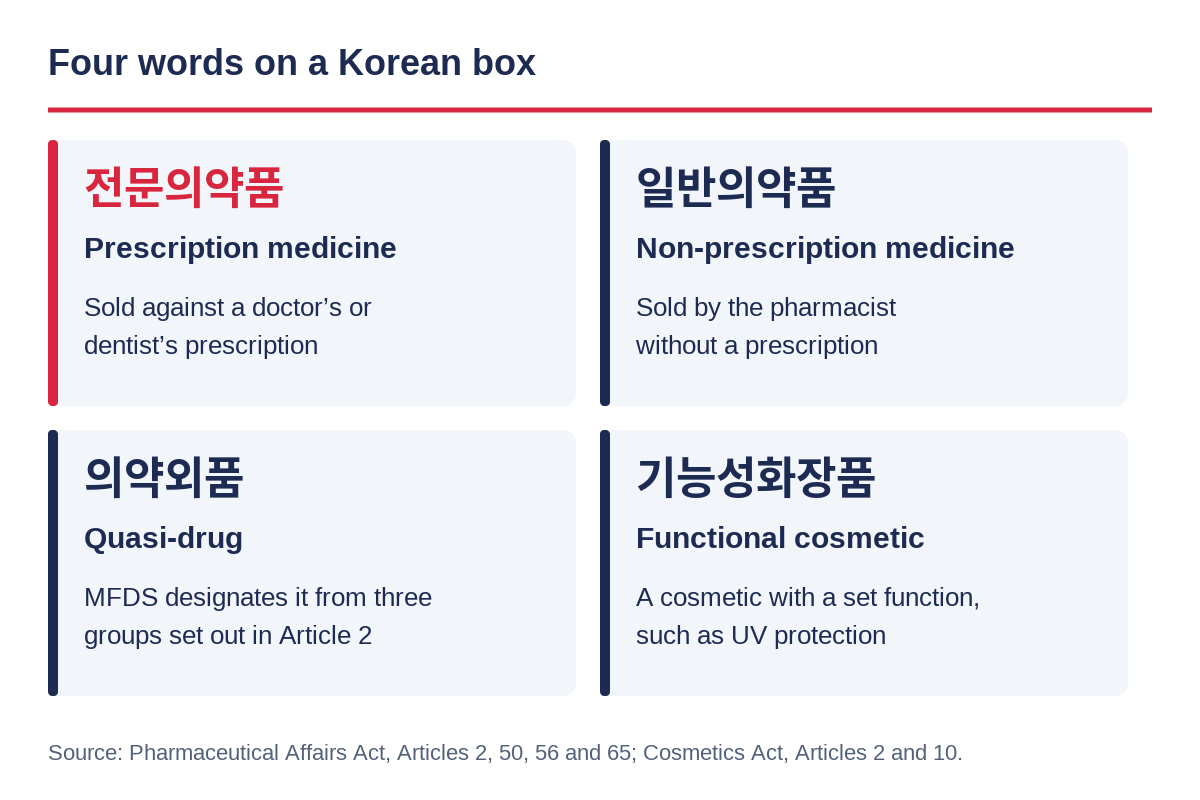
| Word on the box | In English | How the law defines it |
|---|---|---|
| 전문의약품 (jeonmun-uiyakpum) | Prescription medicine | Any medicine that is not 일반의약품. |
| 일반의약품 (ilban-uiyakpum) | Non-prescription medicine | A medicine in one of three groups that meets criteria the Ministry of Food and Drug Safety sets and publishes in consultation with the Minister of Health and Welfare: medicines unlikely to be misused or abused that can be expected to be safe and effective when used without a doctor’s or dentist’s prescription; medicines that can be used to treat disease without a doctor’s or dentist’s expert knowledge; and medicines with comparatively few side effects on the body, given their dosage form and pharmacological action. |
| 의약외품 (uiyakoepum) | Quasi-drug | A product the Ministry of Food and Drug Safety designates from three groups: fibre, rubber or similar products used to treat, relieve, manage or prevent disease in people or animals; products that act weakly on the body or not directly on it and are not instruments or machines, and similar products; and preparations used to kill germs or insects, or for similar uses, to prevent infectious disease. It excludes products used for the purposes that Article 2, items 4(b) and 4(c), give for medicines: to diagnose, treat, relieve, manage or prevent disease in people or animals, or to affect their structure and function pharmacologically. |
| 기능성화장품 (gineungseong-hwajangpum) | Functional cosmetic | A cosmetic, specified by Prime Ministerial ordinance, that helps whiten the skin; improve wrinkles; tan the skin or protect it from UV; change hair colour, remove hair or nourish hair; or prevent or improve dryness, cracking, hair loss, scaling and the like caused by weakened skin or hair function. Cosmetics exclude anything that is a medicine. |
The first three definitions are in Article 2 of the Pharmaceutical Affairs Act, the fourth in Article 2 of the Cosmetics Act (checked 2026-10-24).
What can I buy at a Korean pharmacy without a prescription?
Article 50 of the Pharmaceutical Affairs Act states that a pharmacy sells 전문의약품 only when it is dispensing a doctor’s or dentist’s prescription, and that it may sell 일반의약품 without one (Article 50, checked 2026-10-24). When you buy 일반의약품, the pharmacist may give medication guidance, which Article 2 describes as helping you choose the product you need without making a diagnosis. Describe your skin, where the problem is and how long you have had it, and show anything you are already using.
A short list of 일반의약품 is also sold outside pharmacies. The health minister designates up to 20 products for minor symptoms that need quick relief and that people can judge for themselves, and Article 44-2 requires anyone selling them outside a pharmacy to register, with a shop open 24 hours a day, all year. Their boxes read 일반(안전상비)의약품 (Article 56).
How can I look up a product before buying it?
Type the product name into 의약품안전나라, the Ministry of Food and Drug Safety’s drug database (product search, checked 2026-10-24). The search takes a Korean or English product name or an ingredient, filters by item type, such as 의약품 (medicine) or 의약외품 (quasi-drug), and by 전문 or 일반, and its results table has a column for the English product name.
Keep each medicine in its box until you are home. Article 56 asks for the names of the ingredients and the amount of each active ingredient on the package, so a doctor at home can see exactly what you used.
Which products need a second look?
If you had a laser or injections on this trip, the clinic’s aftercare sheet comes before anything from a pharmacy shelf; aftercare while travelling covers sun, flights and makeup in the first days.
Steroid creams are the other case: a 2026 systematic review of withdrawal reactions after long-term use found them reported mostly in adult women treating atopic dermatitis, usually on the face, and more often after strong creams used for a long time[1].
When does acne need a doctor rather than another product?
The NHS advice on acne gives four signs that it is time to see a doctor (NHS, acne, page last reviewed 22 September 2026, checked 2026-10-24):
- You have treated it yourself and it is not getting better.
- There are many spots, or they are deep, painful or leaving scars.
- The skin looks infected: hot, swollen and red, which can be harder to see on brown and black skin.
- It is affecting your mental health.
A GP may offer treatment you can only get with a prescription, or refer you to a dermatologist. An examination also tells apart problems that look alike at first, such as autumn dryness and dermatitis.
How do I pack creams and sunscreen for the flight home?
On international flights from Incheon, every liquid, gel or spray in your cabin bag must be in a container of 100 ml or less, judged by the size of the container rather than what is left in it, and all of them must fit in one transparent resealable bag per person, which the airport describes as 1 L and 20 cm × 20 cm (Incheon Airport, restricted items, checked 2026-10-24). Sunscreen, lotion and toner all count. In checked baggage the airport sets no volume limit for liquids and gels; personal hygiene sprays, such as hair spray, are limited to 500 ml per item and 2 kg (2 L) in total.
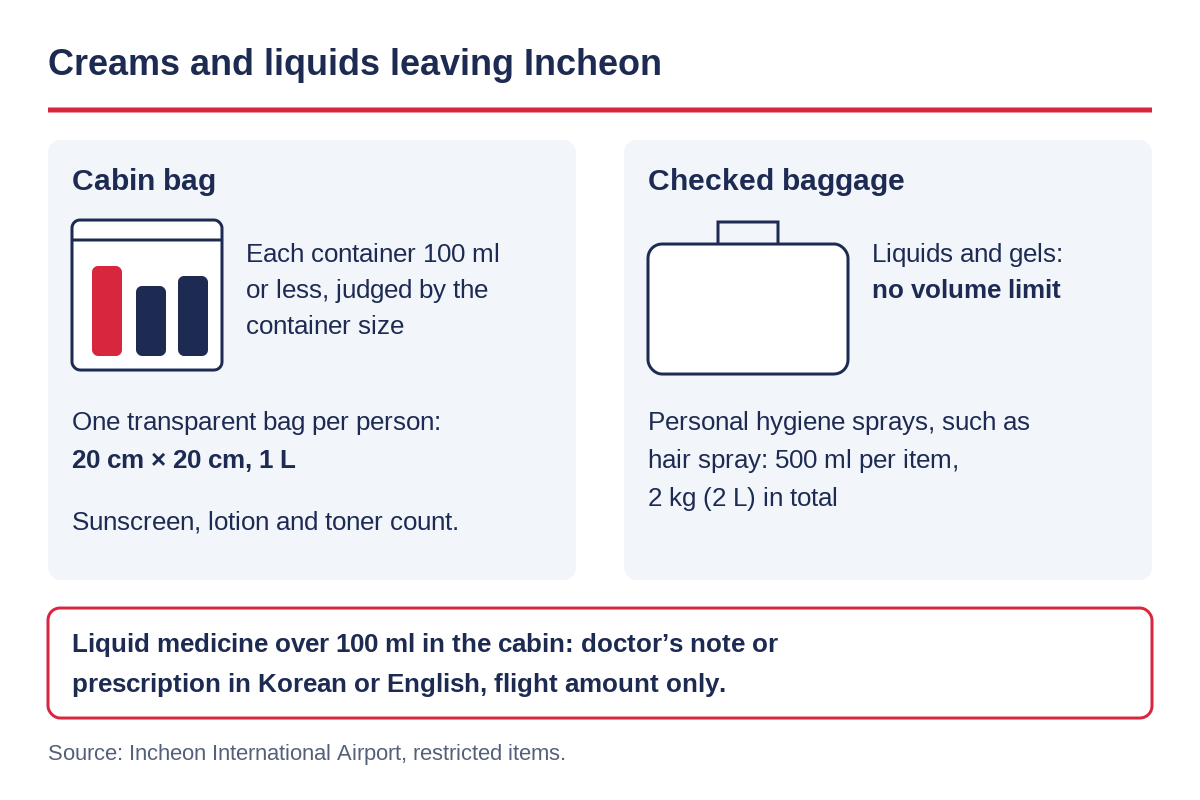
Liquid medicine over 100 ml in the cabin needs a doctor’s note or prescription in Korean or English, and only the amount you need during the flight; the rest goes in checked baggage. Rules for bringing medicines into your home country are set there. For the United States, the FDA’s page on personal importation (content current as of 18 August 2025, checked 2026-10-24) covers medicines that travellers carry in.
Is a sunscreen labelled 기능성화장품 a medicine in Korea?
No. The Cosmetics Act lists protection from UV as one of the functional cosmetic groups, and its definition of cosmetics excludes anything that is a medicine.
Why does a convenience-store medicine say 일반(안전상비)의약품?
It is one of up to 20 non-prescription medicines the health minister designates for minor symptoms. Shops that sell them outside a pharmacy register to do so and open 24 hours a day, all year.
Can I take a 200 ml lotion in my cabin bag from Incheon?
No. The limit is 100 ml per container, judged by the size of the container. Pack it in checked baggage, where liquids and gels have no volume limit.
What does 의약외품 on a box mean?
Quasi-drug. A product the Ministry of Food and Drug Safety designates from three groups: fibre, rubber or similar products used to treat, relieve, manage or prevent disease in people or animals; products that act weakly on the body or not directly on it and are not instruments or machines, and similar products; and preparations used to kill germs or insects, or for similar uses, to prevent infectious disease. It excludes products used for the purposes that Article 2, items 4(b) and 4(c), give for medicines: to diagnose, treat, relieve, manage or prevent disease in people or animals, or to affect their structure and function pharmacologically.
References (1)
Each study’s details come from its PubMed record at the U.S. National Library of Medicine.
- Choi H, Orbe M, Esam S, Parker J. An Updated Systematic Review of Topical Corticosteroid Withdrawal (TCSW): Steroid Addiction or Adverse Drug Effect? Cureus. 2026;18(4):e107365.PubMed: 42170112