Korean facial at a skin clinic or a skin-care shop: what each is allowed to do
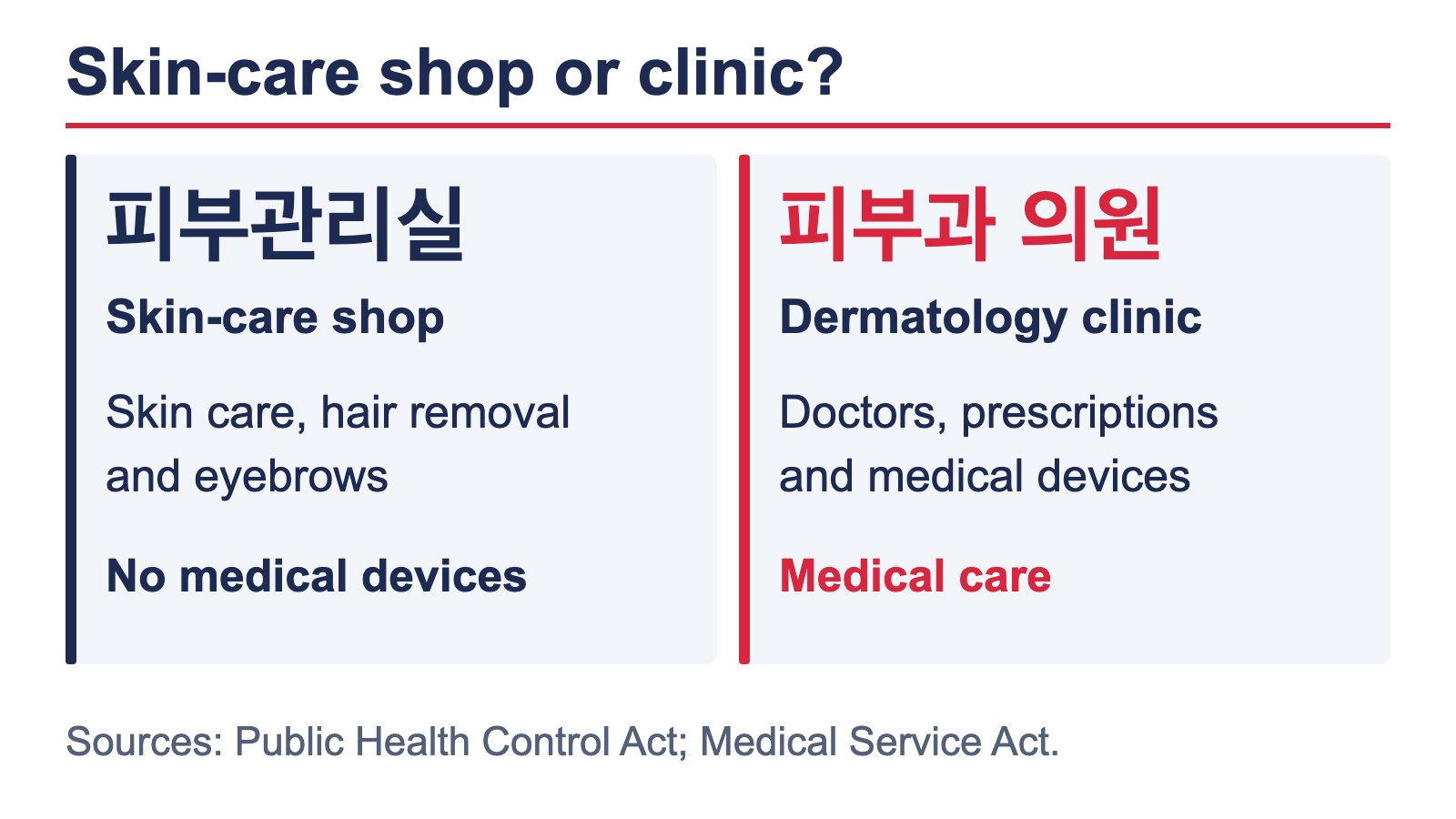
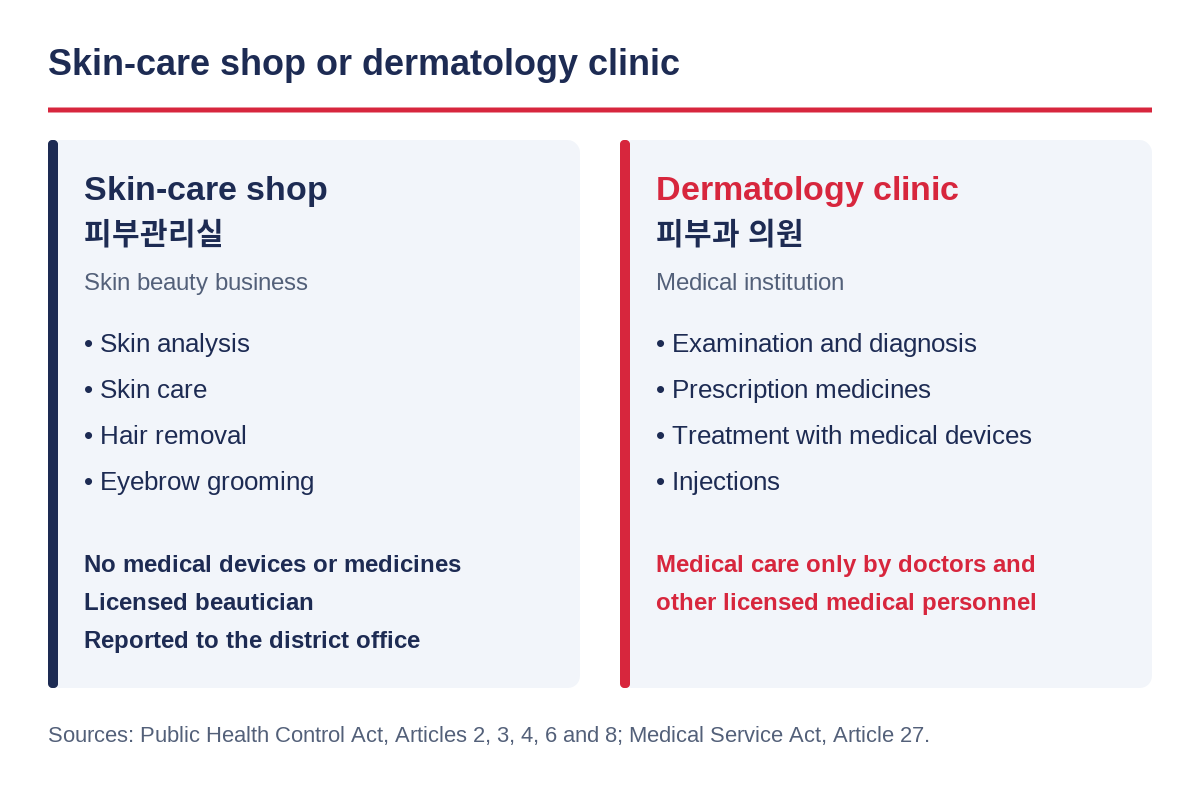
A Korean facial can mean two different places. A skin-care shop (피부관리실) is a skin beauty business: Korean law limits it to skin analysis, skin care, hair removal and eyebrow grooming done without medical devices or medicines, by licensed beauticians. A dermatology clinic (피부과 의원) is a medical institution, where only doctors and other licensed medical personnel may give medical care. A skin-care shop’s permitted services exclude medical devices and medicines.
Edited by Korea Skin Guide. Published · Updated
What may a Korean skin-care shop do?
The Public Health Control Act defines a skin beauty business (피부미용업) as a business that provides skin analysis, skin care, hair removal and eyebrow grooming without using medical devices or medicines (Public Health Control Act, Article 2(1)5(b), checked 2026-11-01). The same Act tells beauty businesses to give only pure cosmetic or skin beauty care without medical instruments or medicines, to store disinfected tools apart from those not yet disinfected, and to display the beautician’s licence inside the shop (Article 4).
A shop is reported, with the required facilities, to the city, county or district office before it opens (Article 3). The person giving the care needs a beautician (미용사) licence from the local government, which the Act grants after studying beauty at school or obtaining a national beautician qualification (Article 6), and only licence holders may open a beauty business or work in one; an assistant may help under a licensed beautician’s supervision (Article 8).
| What to compare | Skin-care shop (피부관리실) | Dermatology clinic (피부과 의원) |
|---|---|---|
| What it is in law | A skin beauty business under the Public Health Control Act | A medical institution under the Medical Service Act |
| What it offers | Skin analysis, skin care, hair removal and eyebrow grooming | Medical care: examination, diagnosis, prescriptions and treatment |
| Medical devices and medicines | Not allowed | Used as part of medical care |
| Who gives the care | A licensed beautician, or an assistant under one | Doctors and other licensed medical personnel |
| What you can check | The beautician’s licence displayed inside | The clinic name, which must name its type, such as 의원 |
What can only a clinic do?
Under the Medical Service Act, nobody but medical personnel may perform medical acts, and medical personnel may perform only those their licence covers; no one may have a person without a medical licence perform them (Medical Service Act, Article 27, checked 2026-11-01). A medical institution must use the name of its type, such as 의원 (clinic), and no other business may use a medical institution’s name or a similar one (Article 42).
In practice, a treatment that uses a medical device or a medicine sits outside what a skin-care shop may offer. How specialists and treatment fields appear on clinic signs is explained in how Korean skin clinics work.
What did the Supreme Court say?
In a 2016 judgment, the Supreme Court read the definition of the skin beauty business, then set out in the Act’s Enforcement Decree, together with the rule that skin beauty work may not use medicines or medical devices. It held that a skin beauty business that uses medical devices is prohibited under the Public Health Control Act, and that the definition marks out the scope of a lawful skin beauty business (Supreme Court judgment 2015do13698, 12 May 2016, checked 2026-11-01). In that case the business itself was found not to be a beauty business at all, because customers used the device on their own faces and staff did not touch their skin.
The definition the court read now sits in the Act itself, in Article 2(1)5(b), in the same terms: skin analysis, skin care, hair removal and eyebrow grooming without medical devices or medicines.
Why the difference matters to visitors
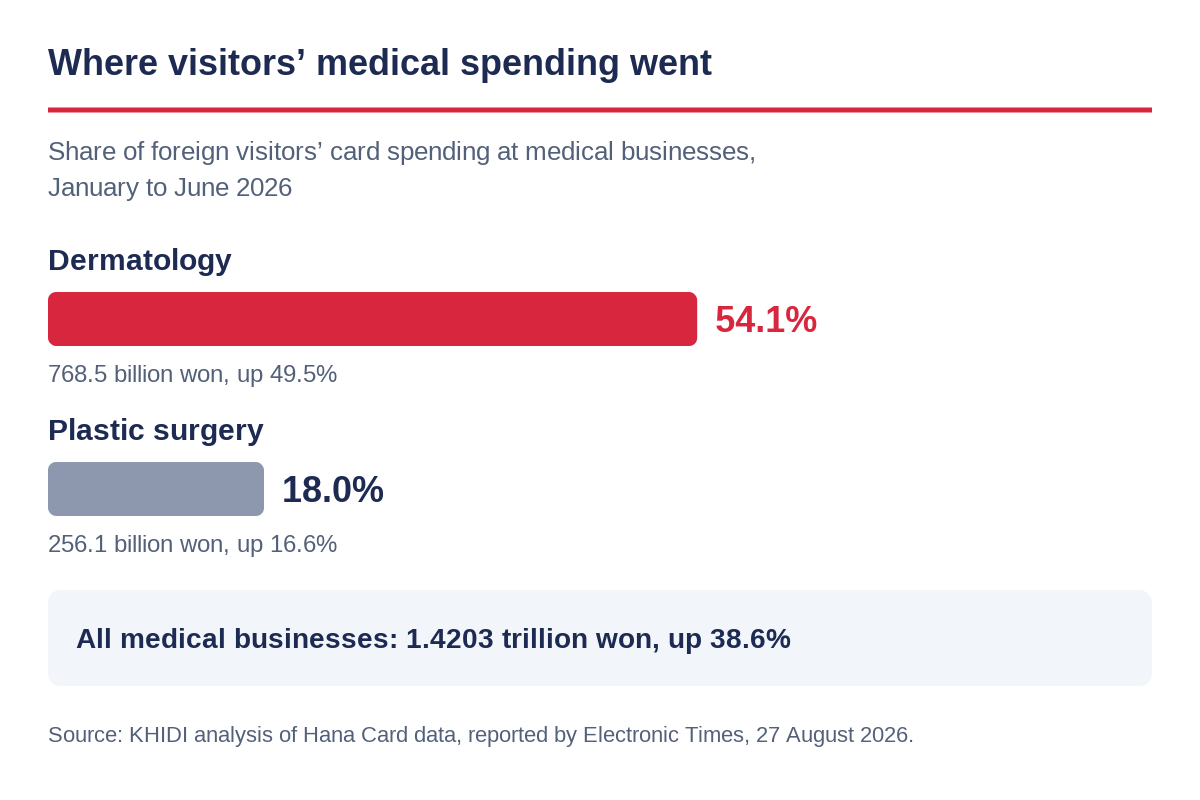
Dermatology now takes most of what short-stay visitors put on their cards at Korean medical businesses. A Korea Health Industry Development Institute (KHIDI) analysis of Hana Card data on payments made in Korea with overseas-issued cards found that, from January to June 2026, foreign visitors spent 1.4203 trillion won at medical businesses, 38.6% more than a year earlier. Dermatology took 768.5 billion won, up 49.5% and 54.1% of the total, against 256.1 billion won and 18.0% for plastic surgery. The analysis left out foreigners registered as residents and those covered by Korean health insurance (Electronic Times, 27 August 2026, checked 2026-11-01). The 2025 patient numbers are in Korea medical tourism skin figures for 2025.
How can you tell which one you are booking?
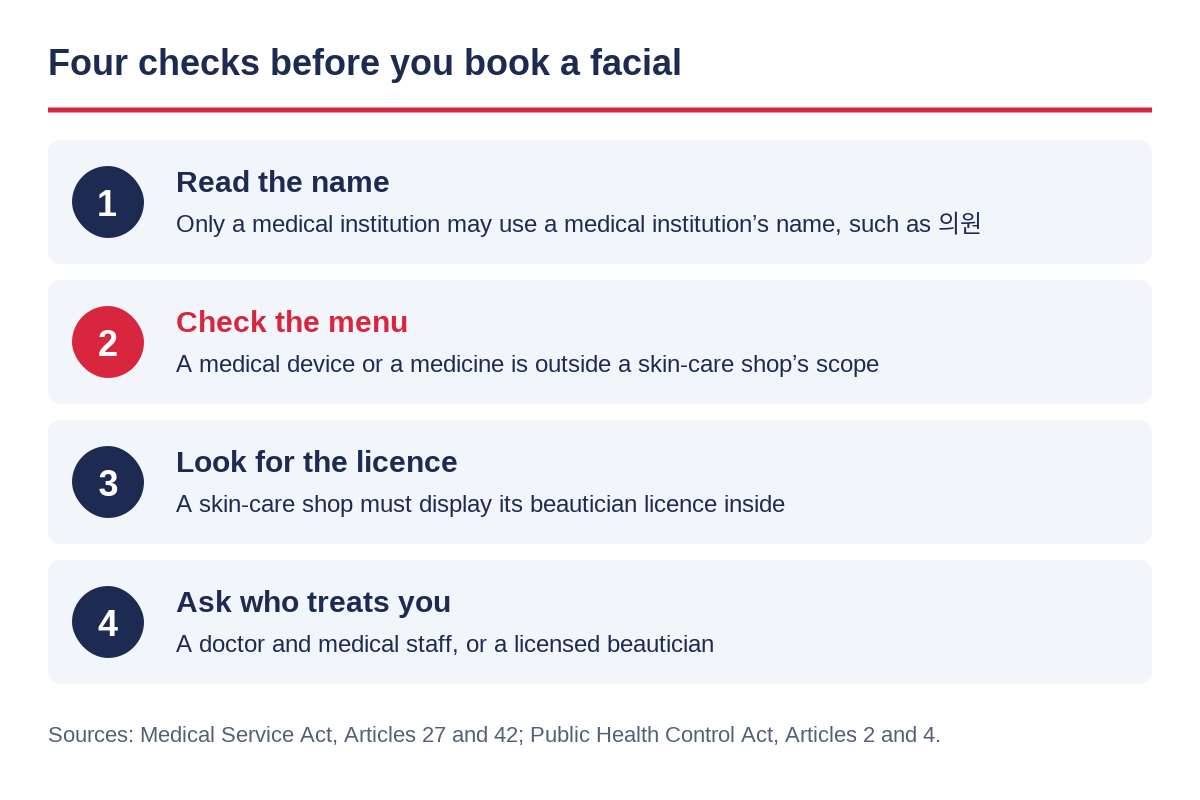
- Read the name. A clinic’s name must include its type, such as 의원, and only a medical institution may use a medical institution’s name.
- Check the menu. A treatment that uses a medical device or a medicine is outside a skin-care shop’s scope.
- Look for the licence. A skin-care shop must display its beautician’s licence inside.
- Ask who will treat you. At a clinic, medical treatment comes from a doctor or other licensed medical staff; at a shop, the care comes from a licensed beautician.
Clinics can offer facials as well. A dermatology clinic’s facial menu in Gangnam, for example, lists superficial peels, hydrodermabrasion and iontophoresis as comfort and maintenance care, chosen after a skin assessment. To check that a clinic is registered to treat foreign patients, see checking a clinic before you book.
Can a Korean skin-care shop do hair removal?
Yes, without medical devices or medicines. Hair removal is part of the legal definition of a skin beauty business, which excludes the use of medical devices and medicines.
Can a skin-care shop use medicines on my skin?
No. The Public Health Control Act tells beauty businesses to give only pure cosmetic or skin beauty care without medical instruments or medicines.
What is the difference between an esthetician and a dermatologist in Korea?
A skin-care beautician holds a beautician licence issued by the local government, and works within the skin beauty business. A dermatologist is a doctor; only medical personnel may perform medical acts such as diagnosis and prescribing.
Is a 피부관리실 the same as a 피부과?
No. A 피부관리실 is a skin-care shop reported to the district office as a skin beauty business; a 피부과 is a dermatology clinic, a medical institution with doctors.